
Beyond the label Beyond the binary
Sep 6, 2026
story
Seeking
Visibility

Reflections on conversation, Human Rights, Science, So
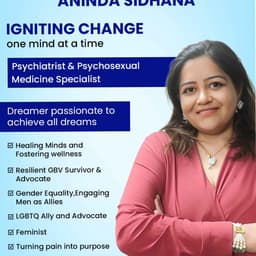
By Dr. Aninda Sidhana
Rohtak, 2010. One Talk.
Sometimes one conversation changes the direction in which we look at our profession.
Sometimes, perhaps, one talk is enough.
In 2010, I was still trying to make peace with Psychiatry.
There were questions in my head that probably sound almost funny to me today.
Why Psychiatry?
Why not Radiology?
Why not Neurology?
Had I chosen the right branch?
And then I heard Dr. Nimesh G. Desai Sir speak at Rohtak.
I cannot claim to remember every sentence from that lecture sixteen years later.
But I remember what it did to me.
It made me see Psychiatry differently.
Suddenly, Psychiatry did not seem like a narrow branch of medicine.
It seemed enormous.
There was the brain, of course.
There was biology.
There was medicine.
But there was also the mind.
There was society.
Culture.
Relationships.
Gender.
Disability.
Law.
Human rights.
Ethics.
Philosophy.
And behind all of them was perhaps the most fascinating subject of all:
the human being.
That day, something changed.
I remember thinking:
Yes. Psychiatry is a good branch. And there is so much one can do within—and beyond—it.
Sixteen years later, Sir still has the same effect on me.
Except today I know what to call it.
Intellectual hunger.
Even One Word With Sir Is Enough for a Full Blog
I have said this many times, half jokingly and completely seriously:
“Even one word with Sir is enough for a full blog.”
Because a conversation with Dr. Desai rarely leaves me thinking:
Wonderful. Now I know the answer.
Quite the opposite.
It opens what I call my Pandora's box.
One observation leads to another question.
One historical reference makes me want to find a paper.
One perspective makes something I thought I understood suddenly appear incomplete.
One answer produces three more questions.
And suddenly I want to read again.
That, to me, is one of the most extraordinary gifts a teacher can give a student.
There are teachers who give us information.
There are teachers who give us answers.
And then there are teachers who leave us hungry enough to keep searching for our own.
Sixteen Years Later: A Dream Comes True
This year, something happened that the person sitting in Rohtak in 2010 could never have imagined.
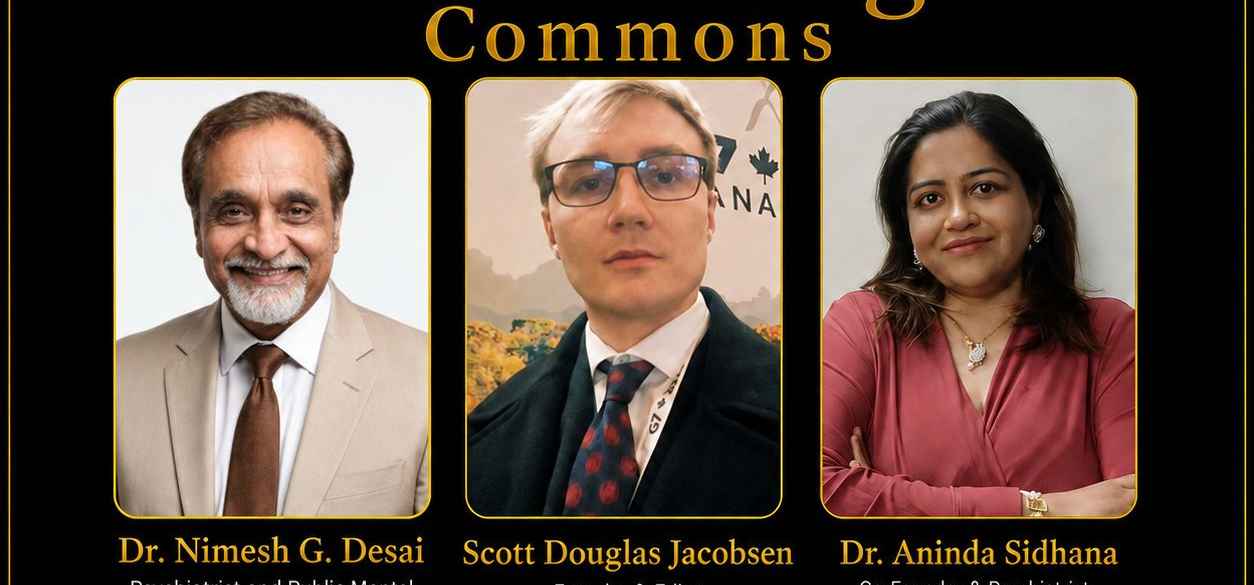
I had the privilege of sitting in conversation with Dr. Nimesh G. Desai Sir on The Listening Commons.
And yes, despite all the intervening years, I entered with anxiety. 😄
I remember asking Scott beforehand:
At least tell me some questions.
What if I freeze?
Give me something so I can revise!
And the broad direction I received was essentially:
The landscape of mental health across history and cultures.
I remember thinking: Is that all the preparation I am getting? 😄
But perhaps that was exactly what this conversation needed.
Not an interrogation.
Not a perfectly choreographed sequence of questions.
A conversation.
And what followed went far beyond what I could have prepared for.
---
From Psychiatry to the Human Condition
We began with mental health.
But soon we were travelling across decades of psychiatric thinking.
We spoke about how the field has changed.
About an earlier era when information itself was difficult to access and the challenge was finding knowledge.
And about our present era, where information is everywhere and perhaps our greater challenge is learning how to filter, integrate, question and understand it.
We moved through Psychiatry and the broader landscape of mental health.
And that distinction itself became fascinating.
Psychiatry has an essential medical responsibility.
Diagnosis matters.
Biology matters.
Treatment matters.
Severe mental illness matters.
Risk matters.
But human mental health does not begin and end at the clinic door.
It exists in relationships, families, workplaces, schools, cultures, economies, digital environments and communities.
So perhaps sometimes the most important question is not only:
“What diagnosis does this person have?”
But:
“What does this particular human being need from us at this particular moment?”
---
The Biological Revolution Was Necessary
One of the most important points in our conversation concerned the role of the life sciences.
The progress Psychiatry made in understanding and treating severe mental illnesses such as schizophrenia could not have occurred without advances in biology, neuroscience, medicine and psychopharmacology.
That deserves to be stated clearly.
Social understanding alone could not have produced everything modern treatment has made possible.
Biology matters enormously.
But recognising the importance of biology does not require us to conclude that biology explains everything.
And this led naturally to another fascinating chapter in the history of Psychiatry.
---
The Biomarker Dream
For decades, Psychiatry has lived with the hope that biological markers might eventually provide objective answers for conditions such as schizophrenia or bipolar disorder.
It is an understandable dream.
Imagine being able to identify illness with biological precision.
To predict risk.
To classify more accurately.
To tailor treatment.
To intervene earlier.
Science continues to move forward, and the future may indeed bring forms of precision neuroscience and biological intervention that today remain beyond routine clinical practice.
But the human brain—and the human being—have repeatedly proved more complex than our models.
And that raises an important distinction:
Precision is not the same as completeness.
A biomarker may tell us something profoundly important about biology.
But can it tell us what loneliness means to one particular person?
Can it measure humiliation?
Can it reconstruct a broken relationship?
Can it prescribe belonging?
Can it restore dignity?
Can it tell somebody:
“You matter”?
Perhaps the future of Psychiatry should not be imagined as:
Biomarker OR bedside.
Perhaps it is:
Biomarker + bedside.
Life Sciences or Social Sciences? Perhaps That Is the Wrong Question
This became one of the strongest ideas I carried away from the conversation.
We love binaries.
Biological or psychosocial?
Brain or mind?
Medicine or society?
Science or humanity?
But perhaps we have spent too much time asking which side should win.
Without life sciences, our understanding of serious illness could remain compassionate yet therapeutically inadequate.
Without social sciences, treatment could become technically sophisticated yet humanly incomplete.
One helps us understand mechanism.
The other helps us understand meaning.
Maybe life sciences and social sciences were never meant to defeat one another.
Maybe they were meant to complete one another.
Because we may treat an illness biologically—
but recovery still has to happen in a life.
---
Culture Walks Into the Consulting Room Too
Our conversation then travelled into culture.
The history of Psychiatry contains important attempts to establish diagnostic reliability across countries and cultures.
A shared clinical language matters enormously.
But culture does not disappear simply because we have agreed upon diagnostic criteria.
Culture influences how distress is expressed.
What families recognise.
What societies tolerate.
What becomes shameful.
What becomes illness.
How someone asks for help.
Whether they ask for help at all.
The same symptom does not necessarily carry the same meaning in every life.
Perhaps:
The diagnosis may travel across cultures. The story surrounding the diagnosis never travels without context.
This matters particularly in societies such as ours, where family can simultaneously be an extraordinary protective resource and a source of expectations, obligations, pressure and silence.
The person sitting before us never enters the consulting room alone.
Their history enters with them.
Their relationships enter.
Their gender enters.
Their economic circumstances enter.
Their culture enters.
---
When Diagnosis Becomes Too Much
As Psychiatry has developed, its classifications have expanded.
That progress has brought enormous benefits.
Diagnosis gives clinicians a shared language.
It can guide treatment.
It can validate suffering.
It can allow somebody who has struggled for years to finally understand that what they are experiencing has a name and can be treated.
But there is another question worth asking.
Can we sometimes psychiatrise too much?
Not every sadness is depression.
Not every fear is an anxiety disorder.
Not every difference is pathology.
Not every painful chapter in a human life requires a psychiatric identity.
This is not an argument against diagnosis.
It is an argument against allowing diagnosis to swallow the person.
A diagnosis can guide treatment. It should never become the entirety of a human identity.
Perhaps the success of Psychiatry cannot be measured simply by how many conditions we can classify.
It must also be measured by:
What happens to the life behind the label?
---
Who Did Medicine Originally Call “Normal”?
Then our conversation moved to women.
Sir spoke about something deceptively simple but historically important: much of medicine's understanding of the “healthy person” developed from evidence in which adult male bodies were disproportionately represented.
That immediately made me wonder:
Who was the “healthy human” medicine originally built around?
Women are not simply smaller versions of men.
Hormonal transitions matter.
Reproductive events matter.
Pregnancy matters.
The postpartum period matters.
Menopause matters.
But biology is again only part of the story.
Gender expectations matter.
Violence matters.
Caregiving matters.
Economic dependence matters.
Relationships matter.
Culture matters.
And perhaps inclusion cannot simply mean inserting women into an existing model.
Sometimes we need to ask whether the model itself requires reconsideration.
Whose body became the textbook?
Whose experience became the norm?
And whose suffering remained outside the criteria?
Nothing About Us Without Us
Sir's experiences around disability and human rights brought four enormously powerful words into the conversation:
Nothing About Us Without Us.
The principle reaches far beyond disability.
It matters for women.
For people living with mental illness.
For survivors.
For marginalised communities.
For anyone whose life is being discussed in rooms where they themselves have historically had little power.
Representation cannot simply mean occupying a chair.
Representation becomes meaningful when the person invited into the room has enough agency to change what the room decides.
Lived experience should not merely decorate evidence.
Sometimes lived experience must be allowed to challenge the very questions from which our evidence begins.
---
Women, Depression and the Burden We Normalise
We also discussed the familiar teaching that depression is reported more commonly among women.
But statistics should start questions—not end them.
What exactly are we measuring?
Biology?
Hormonal transitions?
Pregnancy?
Violence?
Caregiving?
Economic circumstances?
Social expectations?
Differences in help-seeking?
Differences in how distress is expressed or recognised?
Perhaps we need to ask:
What are women being asked to carry—biologically, psychologically and socially—and how much of that burden have we normalised?
We praise women for resilience.
Perhaps sometimes we should instead ask:
What keeps requiring this person to be resilient?
How much pain disappears behind words such as:
Duty.
Adjustment.
Sacrifice.
Strength.
Sometimes the beginning of care may simply be:
I hear you.
You matter too.
---
Human Rights: Where Easy Answers End
And then we entered perhaps the most difficult part of our conversation.
Human rights.
Psychiatry's history gives us every reason to protect autonomy, dignity, voice and self-determination.
Human-rights frameworks have forced mental-health systems to confront coercion and to recognise the person before the patient.
That progress matters profoundly.
Dignity before diagnosis.
But clinical reality can confront us with situations in which principles collide.
What happens when severe illness significantly affects someone's capacity to recognise their need for care?
What happens when there is serious risk?
How do we respect autonomy while also respecting beneficence, non-maleficence and justice?
And so I found myself asking:
How do we protect someone's rights without abandoning them in the name of those rights?
But equally:
How do we provide necessary care without using “care” as justification for taking away dignity, voice or agency?
Neither coercion disguised as care.
Nor abandonment disguised as autonomy.
Perhaps good Psychiatry must live in that uncomfortable space.
---
Utopia—or Negative Utopia?
At this point, the conversation pushed me into philosophical territory.
I began wondering about utopia and its shadow.
What happens when a society becomes so committed to creating the safest, fairest or most ideal system that the pursuit of perfection itself begins to constrain the imperfect human beings living inside it?
The idea of a “negative utopia” or dystopia has long been used to imagine societies that appear—or aspire—to solve human problems but become worse places to live.
And the underlying tension between individual freedom and collective social ideals is hardly new. George Herbert Mead, for example, treated freedom as something that exists within a social world where one person's freedom can conflict with another's; his thought was also wary of simplistic utopian solutions detached from actual social conditions.
My question after our conversation was not theoretical alone.
It was profoundly relevant to mental health:
When does protection become paternalism?
When does autonomy become abandonment?
When does safety begin to consume freedom?
And can a system created with the best intentions eventually protect people from so much that it also protects away part of their agency?
I do not have a neat answer.
Perhaps that is why the question matters.
The task cannot be to choose between absolute freedom and absolute protection.
It must be to preserve the maximum possible dignity, autonomy and agency while responding compassionately when illness genuinely compromises a person's ability to protect themselves or others.
That balance is difficult.
It should remain difficult.
Human beings deserve more than easy answers.
Severe Mental Illness Must Not Become Synonymous With Dangerousness
Any discussion of risk also requires another caution.
Severe mental illness must never become shorthand for violence.
People living with schizophrenia or other serious psychiatric illnesses should not be defined by exceptional cases of dangerous behaviour.
Where genuine risk exists, the assessment must be individual.
What is this person's present condition?
What is their capacity?
What is the actual risk?
What intervention is necessary?
And what is the least restrictive, most dignified way of providing it?
Because:
The right to autonomy, the right to safety and the right to receive care can all belong to the same human being.
---
Awareness Is Not Access
Our conversation also returned home—to India.
Mental-health awareness has changed dramatically.
COVID accelerated conversations about psychological distress.
Mental health is spoken about more openly.
Stigma has shifted in many spaces.
Services have expanded.
But:
Awareness is not access.
Can someone reach a service?
Can they afford it?
Can they trust it?
Will they be understood?
Will they receive continuity of care?
Will help exist outside major cities?
Will they be treated as a person rather than a case?
Perhaps the treatment gap is also a:
Trust gap.
Listening gap.
Dignity gap.
Belonging gap.
And that is why mental health cannot remain confined to specialist clinics.
It belongs in primary care.
Schools.
Universities.
Workplaces.
Communities.
Media.
Cinema.
Sport.
And increasingly, digital environments.
Mental health is public infrastructure, not a private luxury
Mental Health Is Development
Mental health appearing on national and international development agendas is progress.
But appearing on an agenda is not the same as becoming a genuine priority.
Mental health intersects with education.
Employment.
Poverty.
Gender.
Physical health.
Conflict.
Climate.
Technology.
Social cohesion.
Perhaps mental health should not simply occupy another box on a development agenda.
Perhaps it should become one of the lenses through which we understand development itself.
Hyperconnected—and Yet?
Then came the digital world.
Technology has created extraordinary possibilities.
Information can travel instantly.
People separated geographically can connect.
Mental-health resources can reach individuals who might never walk into a clinic.
Communities can form around experiences that once produced only isolation.
All of this matters.
But Sir's observations also made me think about the other side of digital life.
We may be becoming hyperconnected technologically while remaining deeply under-connected as human beings.
We can have thousands of followers and still feel unseen.
Hundreds of messages and still feel unheard.
Constant notifications and still feel lonely.
We can be visible everywhere and belong nowhere.
Visibility is not belonging.
Attention is not mattering.
And that returns me to a question that increasingly occupies my own thinking:
Do I matter when the applause stops?
Perhaps beneath some of our endless pursuit of achievement, followers, visibility, validation and recognition lies something much older than social media.
A profoundly human fear:
The Fear of Not Mattering.
Technology should augment human connection.
It should never become its complete substitute.
Because a thousand notifications cannot necessarily replace one experience of genuinely being heard.
And Then Came the Most Important Word: UNLEARN
I entered the conversation expecting to learn about mental health.
I did.
I learnt about history.
Science.
Schizophrenia.
Biomarkers.
Culture.
Women.
Disability.
Human rights.
Autonomy.
Technology.
But afterwards, I realised that the most important lesson Sir had given me was something else entirely.
UNLEARN.
To unlearn the idea that every distress needs a diagnosis.
To unlearn labels as identities.
To unlearn criteria as the entire story.
To unlearn the assumption that a textbook is the final word.
To unlearn the idea that expertise means the doctor always speaks and the patient only receives.
To unlearn the comfort of binaries.
Not to abandon science.
To expand its humanity.
Not to reject diagnosis.
To see beyond it.
Not to discard textbooks.
To remember that no human life fits neatly between their pages.
A checklist can identify symptoms.
A textbook can describe a disorder.
A diagnosis can guide treatment.
But none can tell me, entirely, who you are.
What Sir Really Taught Me
When I finally reflected on the conversation, something became clear.
The greatest lesson was not a fact.
It was not a theory.
It was not even an answer.
Sir taught me how to learn.
To go back to the textbook—but not treat it as unquestionable.
To respect evidence—but remember that evidence changes.
To hold a position—but let another perspective make it bigger.
To resist the comfort of binaries.
To listen before answering.
To allow uncertainty to produce curiosity rather than anxiety.
And perhaps most importantly:
Never lose the curiosity to learn.
A teacher can give us information.
A great teacher can give us knowledge.
But perhaps the rarest kind of teacher gives us something else:
Intellectual hunger.
---
From Rohtak 2010 to The Listening Commons 2026
And that is why this Teachers' Day feels different.
In 2010, I sat in an audience in Rohtak and listened to Dr. Nimesh G. Desai Sir.
That talk helped a young trainee stop asking “Why Psychiatry?” and begin imagining what Psychiatry could become.
Sixteen years later, I had the privilege of sitting across from him in conversation.
I entered anxious about what I would say.
I entered prepared to learn about mental health.
I left thinking about what it means to be human.
Perhaps that is the full circle.
The teacher who once made me believe in Psychiatry now reminds me not to become imprisoned by what I think I know about Psychiatry.
To keep learning.
To keep questioning.
To keep listening.
And, when necessary—
to unlearn
Do We Care?
Our science will change.
Our classifications will change.
Our technology will change.
Our textbooks will change.
Perhaps we should too.
But one commitment should remain:
Our loyalty must not be to the label, the ideology or the model. Our loyalty must remain with the person.
Beyond the label.
Beyond the diagnosis.
Beyond the clinic.
To listen.
To understand.
To belong.
To matter.
Happy Teachers' Day, Dr. Nimesh G. Desai Sir. 🙏
Thank you for making me believe in Psychiatry in 2010.
Thank you for continuing to make me question it—not because it matters less, but because the human being must always matter more.
Thank you for every Pandora's box.
For every question.
For making me go back and read.
And above all:
Thank you for not simply teaching me what to think. Thank you for reminding me how to learn.
Sixteen years later, I am still learning.
Perhaps that is the greatest tribute a student can give her teacher.
— Dr. Aninda Sidhana
- Leadership
- Health
- Human Rights
- Education
- Stronger Together
- South and Central Asia