
From Collective Intelligence to Collective Care: What SIG Lab Taught Me About Human-Led AI
Sep 9, 2026
story
Seeking
Visibility


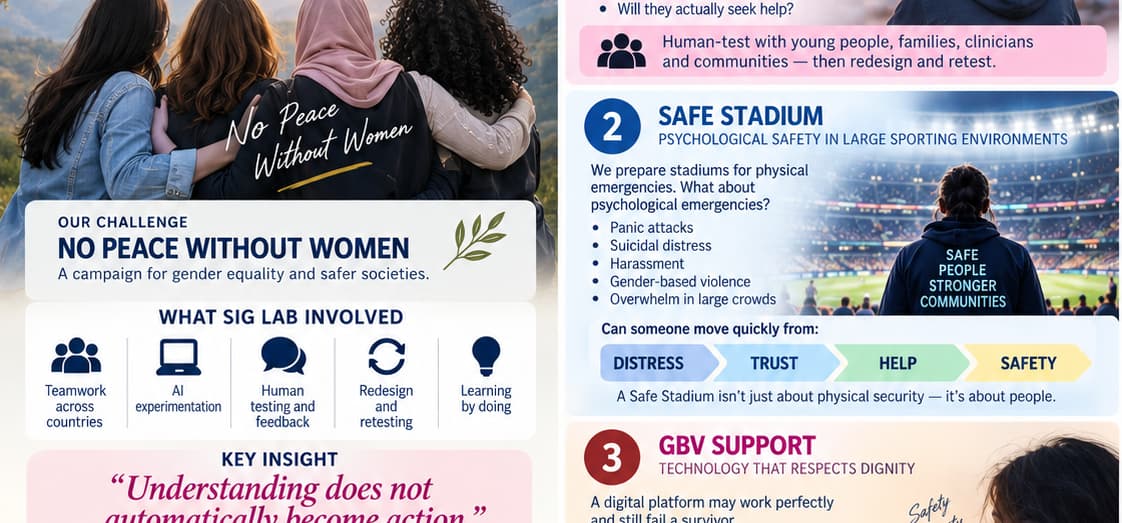
From Collective Intelligence to Collective Care: What SIG Lab Taught Me About Human-Led AI in Mental Health
I recently completed SIG Lab 2026 in AI-Augmented Collective Intelligence, working within an international cross-sector cohort on the applied challenge No Peace Without Women.
The most important lesson I carried away was surprisingly human:
Understanding does not automatically become action.
Our work involved homework, international teamwork, AI-assisted exploration, real-world human testing, feedback, redesign and retesting. It made me ask a question from my own field of psychiatry:
What if we used collective intelligence not simply to build better technology, but to build mental-health systems people actually trust?
Consider suicide prevention. We often tell people, “Reach out. Ask for help.” But have we tested that message with the person who is frightened, ashamed, isolated or unsure where to go? A message can be clinically correct and still fail at the moment it matters.
Consider a Safe Stadium. Stadiums prepare extensively for physical emergencies. But psychological safety matters too. What happens when a young spectator experiences suicidal distress, someone has a panic attack, or a woman experiences harassment or gender-based violence? The real measure is whether a person can move from:
Distress → Trust → Help → Safety.
And consider GBV technology. A platform may function perfectly from a technical perspective while feeling unsafe to a survivor. Does its language preserve dignity? Is consent meaningful? Can someone exit safely? What happens after disclosure?
These are not questions AI should answer alone.
AI can widen the inquiry.
Evidence can guide us.
Lived experience can expose blind spots.
Communities bring context.
Humans must remain accountable.
I entered SIG Lab thinking about collective intelligence.
I leave thinking about collective care.
Perhaps the future of AI in mental health is not about replacing human judgement. It is about helping us listen to more voices, test our assumptions and design better solutions with people rather than merely for them.
The programme is complete. The real homework begins now.
- Girl Power
- Gender-based Violence
- Economic Power
- Global