
Gender Equality: Don't Just Read It, Make It Real
Aug 5, 2026
story
Seeking
Action


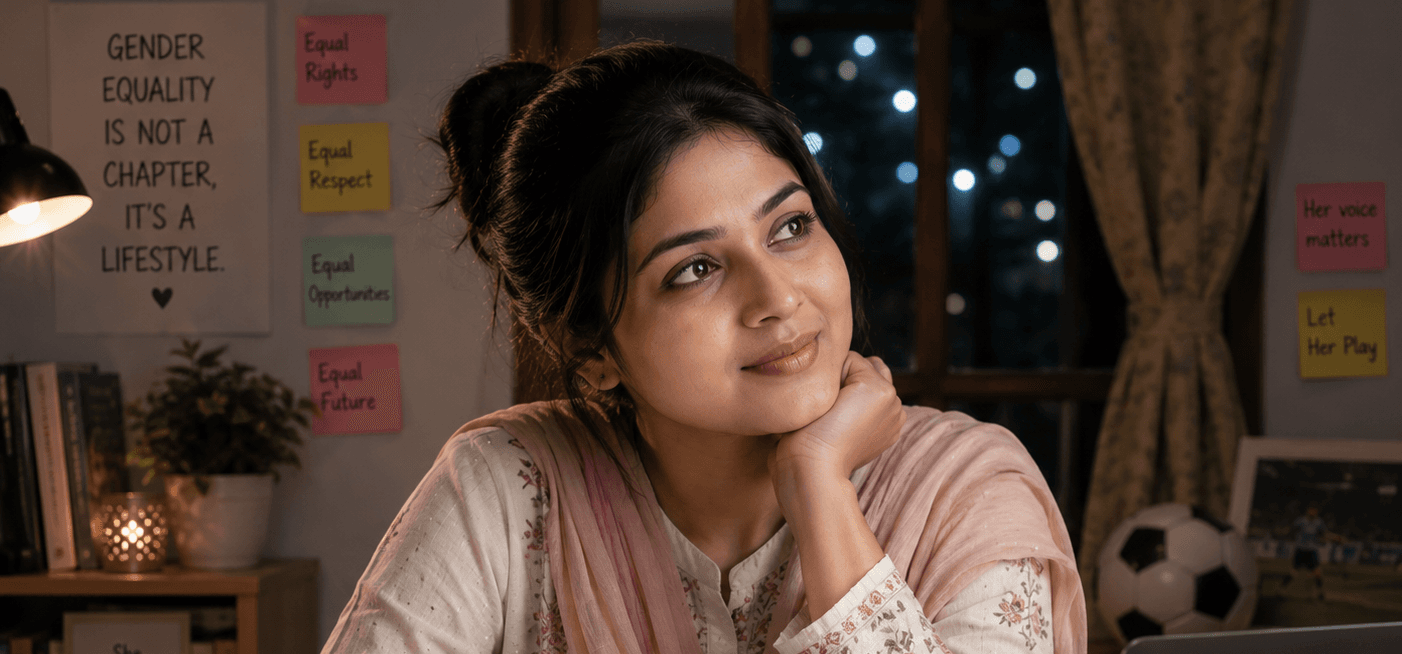
Level up your confidence and stand up for yourself
Gender discrimination is a topic we are introduced to from primary school through higher education. We are taught what gender discrimination is, how women face it, and how we can prevent this social problem. But sadly, we often fail to put those lessons into practice. Even in this modern era, most women continue to face gender discrimination in their everyday lives. It exists in our personal lives, professional lives, and even in the way we are expected to enjoy entertainment.
During my childhood, I loved watching a cartoon series called Meena. The cartoon centered around a young girl named Meena, who was her father's favourite. Through Meena's stories and adventures, the series showed how girls were often valued less than boys and why that should never be like this.
When it came to food, Meena's brother, Raju, was often given the bigger portion. Meena's contributions to household chores and even her education were considered less important than her brother's. Yet, in every episode, Meena proved that she was no less important than Raju. Through her wisdom, courage, and kindness, she showed that every child is equally valuable and deserves equal care, love, respect, and opportunities.
It was through Meena that I first learned about gender discrimination and the importance of gender equality. I thought the lessons we learned from Meena would become reality. But as I grew older, I realised that the names and situations may have changed, but the discrimination continues in different forms.
Now, I am over thirty, and I find that we have still not moved beyond the lessons of the cartoon Meena. We continue to face gender discrimination from family life to professional life, from raising our own children to teaching our students, and even in simple things like using a mobile phone or enjoying football matches.
In our personal lives, many people may have higher degrees, yet they still believe that household chores are a woman's responsibility. Even when both husband and wife work outside the home, it is usually the mother who is expected to raise the children, feed them, and do all the cooking, cleaning, and other household work. This is unfair to women.
Many women are financially independent because they work and earn money. However, when it comes to making important decisions, many men do not feel the need to discuss them with their wives. On the other hand, women are somehow expected to discuss every important decision with their husbands. A man is free to support his own family without being questioned, but many women have to think twice before helping their parents or siblings.
No one usually talks about these everyday inequalities or stands beside women. So, I decided to stand by my own side. I divided two or three household responsibilities among my husband, such as taking out the garbage, organising his own room, and helping our elder daughter with her studies.
Sometimes my husband gets irritated, but he still does the responsibilities I have given him. Unfortunately, some women around me do not see this positively, but I don't care.
In professional life, people often think that women are less capable than men. We have to prove our abilities continuously by demonstrating our skills and hard work, whereas male professionals are rarely expected to do the same.
In my workplace, major responsibilities are usually assigned to male teachers, as if everyone assumes that women cannot handle them properly.
One day, one of my male colleagues was struggling with a calculation. When I heard about it, I suggested another way to solve the problem. However, he ignored my suggestion and said, "Madam, it is not as easy as you think."
Another female colleague agreed with me and told him to leave the matter to us and see whether we could solve it or not. It felt like an open challenge, and he accepted it.
Finally, my colleague and I solved the problem successfully. That day reminded me that many people still do not have confidence in women's abilities. As women, we often have to keep proving ourselves again and again before our skills are recognised.
The discrimination I face the most nowadays is in terms of entertainment. I have loved football since my childhood, but many people believe that women cannot understand the game. Men and boys can shout loudly to celebrate a goal, but I have often been told to lower my voice. At work, when the staff discuss the previous night's matches, many of them ignore my comments because they think football is not a woman's thing. However, I do not care much about their opinions. I continue to enjoy football the way I always have.
I have also been told that women should not use social media too much, that I should not upload certain pictures, that I should not be active online at night, and that I should not spend much time on my mobile phone. Men, however, are rarely advised or judged for doing the same things.
One day, I shared a funny post on Facebook. After some time, a few of my distant relatives messaged me, saying that girls should not share posts like that. Even my supportive husband sometimes asks me not to spend so much time on my mobile phone. But they do not realise that I do not use it only for social media or entertainment. I use it to learn new things, connect with people beyond my borders, and take part in social welfare activities. It also helps me reduce stress and protect my mental health.
Every morning, I wake up early, finish my cooking, and go to work. After returning home, I take care of my two daughters and help my elder daughter with her English lessons. Then I prepare dinner, and after putting my younger daughter to sleep, I finally get some time for myself to use my mobile phone.
But whenever my husband sees me using my phone, he sometimes starts arguing that I am addicted to it and that I am setting a bad example for our children, even though they are already asleep and I have finished all my responsibilities. His words hurt me deeply, and I wondered if I was the one doing something wrong. Yet, I never questioned him for playing games on mobile phone or spending time with his friends.
Now, however, I have decided not to let those comments affect me so much. I know I have responsibilities towards my family, and I do my best to fulfil them. But I also deserve to save a little time for myself—to learn, to connect with others, to reduce my work-related stress, and to protect my mental health. It is necessary not selfish.
Thus, women face gender discrimination in their everyday lives. They are often discouraged or not allowed to do simple things that men can do without hesitation.
But we have to raise our voices against it so that women do not have to fight silently every day. It is not enough to read about gender equality in books. we have to practise it in our daily lives. We have to make it real.
- Leadership
- Girl Power
- Human Rights
- Internet Access
- Becoming Me
- Caring for Ourselves
- Global