
Give Me an Educated Mother, and I Will Give You a Civilized Nation
Aug 31, 2026
story
Seeking
Connections


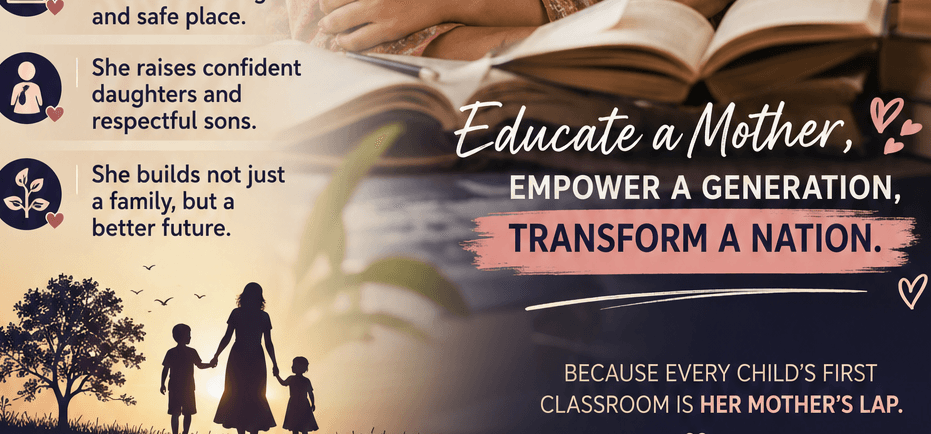
Photo Credit: ChatGPT
An Educated Mother is a source of Strength for her Daughter
Napoleon Bonaparte is often credited with saying, “Give me an educated mother, and I shall promise you the birth of a civilized nation.”
Whether or not these exact words can be historically verified, the idea behind them carries a truth that still speaks to us today: when you educate a woman, you do not educate only an individual—you influence generations.
A mother is often a child's first teacher. Before a child enters a classroom, the child learns from her mother's words, fears, decisions, values and dreams.
But what happens when a daughter becomes educated while her mother remains uneducated?
Sometimes, an invisible distance begins to grow.
Not because the daughter stops loving her mother.Not because the mother stops loving her daughter.But because their worlds begin to speak different languages.
The daughter learns about mental health, career choices, gender equality, financial independence, technology, consent, personal boundaries and changing social realities. Her mother may have grown up in a world where obedience was considered a woman's greatest virtue, where questioning elders was disrespectful, and where a girl's future was often discussed in terms of marriage rather than education or career.
The daughter comes home with new questions.
The mother may respond with old answers.
And sometimes, the daughter feels misunderstood.
A mother may say, “Why do you need to work? Your husband will provide for you.”
The daughter may think, “I don't want to work only because I need money. I want to build something of my own.”
A mother may say, “Girls should compromise.”
The daughter may ask, “But why should compromise always mean sacrificing myself?”
A mother may say, “People will talk.”
The daughter may wonder, “When did other people's opinions become more important than my happiness?”
These differences can create emotional walls between mothers and daughters.
But perhaps the real problem is not that the mother does not love her daughter.
Perhaps she simply was never given the opportunity to learn.
An uneducated mother may have limited choices. An educated mother can help her daughter create choices.
Imagine a girl growing up in a family where her brother is automatically considered the family's future, while she is expected to prepare for marriage.
Her brother is sent to a good school.
She is told that the nearby school is “good enough for a girl.”
Then her educated mother speaks.
She says:
“If my son deserves a good education, my daughter deserves it too.”
That one sentence can change a life.
When the daughter wants to pursue higher education, her mother does not ask, “Who will marry a girl who studies this much?”
She asks:
“What university do you want to attend?”
When relatives say, “She is getting too old for marriage,” the mother does not panic.
She tells her daughter:
“Your marriage is your life decision. I will not choose your husband for you. I will stand beside you while you choose.”
When the daughter says no to a marriage proposal because she is not ready, the mother does not force her to accept it merely to protect the family's reputation.
She protects her daughter's voice.
And when property is inherited, she does not quietly accept the traditional assumption that sons deserve everything while daughters should receive only love and blessings.
She tells her daughter:
“You are not asking for a favour. You are asking for what is rightfully yours.”
This is what education can do.
It can turn a mother from someone who simply loves her daughter into someone who understands her daughter's rights and has the confidence to defend them.
An educated mother can also become her daughter's emotional shelter.
Today's young women face problems their mothers may never have encountered: cyberbullying, online harassment, unrealistic social-media standards, workplace discrimination, academic pressure, career uncertainty, financial dependence, anxiety about the future and the pressure to become “successful” before they have even discovered who they are.
A daughter does not always need her mother to have all the answers.
Sometimes she simply needs her mother to say:
“I may not completely understand your world, but I am willing to listen.”
That sentence can be more powerful than any lecture.
An educated mother can teach her daughter that failure is not shameful.She can tell her that earning money is not greed.
She can teach her financial literacy so that her daughter understands savings, banking, investment and economic independence.
She can encourage her to speak confidently in a room where nobody expects a woman to speak.
She can teach her that kindness does not require surrendering boundaries.
She can tell her that being married is not the definition of being successful.And perhaps most importantly, she can teach her daughter that her worth does not depend on how useful she is to other people.
But education does not mean only degrees.
A mother does not need a PhD to become a source of wisdom.
Education can begin with learning to read, to start understanding a daughter's school report, to start learning about the law, to begin with understanding women's inheritance rights, to start learning using a smartphone safely.
It can begin with asking questions.
It can begin with saying, “I don't know. Let's find out together.”
And when a mother learns, the daughter learns something even more valuable:Learning never has an age limit.
There is another beautiful side to this relationship.An educated daughter can also become a teacher to her mother.
She can teach her how to use digital banking, access online information, explain her legal rights, introduce her to new ideas, start a small business or sell her skills online.
This is why educating girls is never simply about sending a girl to school.
It is about changing the environment in which the next generation will grow.
An educated girl may become an educated mother.
An educated mother may raise children who question injustice instead of accepting it.She may raise sons who understand that household work is not “women's work.”
She may raise daughters who know that their voices matter.
She may teach children that respect is not obedience without question.
She may teach them that equality begins at home.And slowly, one household becomes another.
Perhaps this is what a civilized nation really looks like.So perhaps Napoleon's famous idea should make us ask a different question today:
What kind of nation are we building when we educate our sons but leave our mothers and daughters behind?
If we want educated children, let us educate mothers.
If we want confident daughters, let us empower mothers.
If we want respectful sons, let us educate mothers.
If we want women to know their rights, let us make those rights understandable to every mother.Because the first classroom of a child is often a mother's lap.
And sometimes, the most powerful way to change a nation is to change what a mother believes is possible for her child.
Give a mother knowledge.
Give her a voice.
Give her the confidence to question injustice.And she may give the world something far greater than one educated child.
She may give it a generation that knows how to build a better world.
- Leadership
- Economic Power
- Girl Power
- Education
- Stronger Together
- Our Impact
- Global