
How Manufacturers Can Avoid Approval Bottlenecks and Operational Shutdowns
Jun 12, 2026
story
Seeking
Encouragement


Introduction
India's manufacturing base is scaling at a pace unseen in previous decades. PLI schemes, industrial corridor development, and rising FDI inflows are translating into record volumes of greenfield projects, capacity expansions, and new industrial facility registrations all of which require regulatory clearances before a single machine can legally operate.
For manufacturers investing in new or expanded facilities, industrial licensing and regulatory compliance consulting services in India have become a project-critical function not an administrative afterthought. Regulatory delays do not just push timelines; they trigger cost overruns, jeopardise financing drawdowns, and put PLI-linked production milestones at risk.
The compliance environment has grown significantly more complex. What makes it challenging:
• Multiple parallel approval tracks a single industrial facility requires clearances from 8–12 statutory bodies, each operating on its own timeline, documentation standard, and inspection protocol
• State-level variability licensing is a concurrent subject; requirements in Maharashtra differ materially from those in Tamil Nadu, Gujarat, or Rajasthan
• Sequencing dependencies most approvals cannot run in isolation; a single out-of-sequence filing can invalidate submissions and restart entire tracks
• Digital gaps in NSWS the National Single Window System has variable integration depth across states; several critical approvals still require direct authority engagement outside the portal
The Regulatory Pressure on Indian Manufacturers Is Escalating
India's industrial licensing system was not designed for the volume it now processes. The convergence of PLI scheme activity, FDI growth, and corridor-driven greenfield development is loading state approval systems beyond their historic operating capacity.
Business Impact: State Factory Inspectorates are processing record application volumes without proportional staffing increases. Structural backlogs are no longer exceptional they are the default operating condition in high-demand industrial states such as Maharashtra, Gujarat, Tamil Nadu, Telangana, and Karnataka.
Why Industrial Licensing Delays Are Increasing
1. Multi-Authority Dependency
No single approval for a manufacturing facility exists in isolation. Each clearance sits upstream or downstream of others, creating compulsory sequencing logic that most manufacturers underestimate at the planning stage.
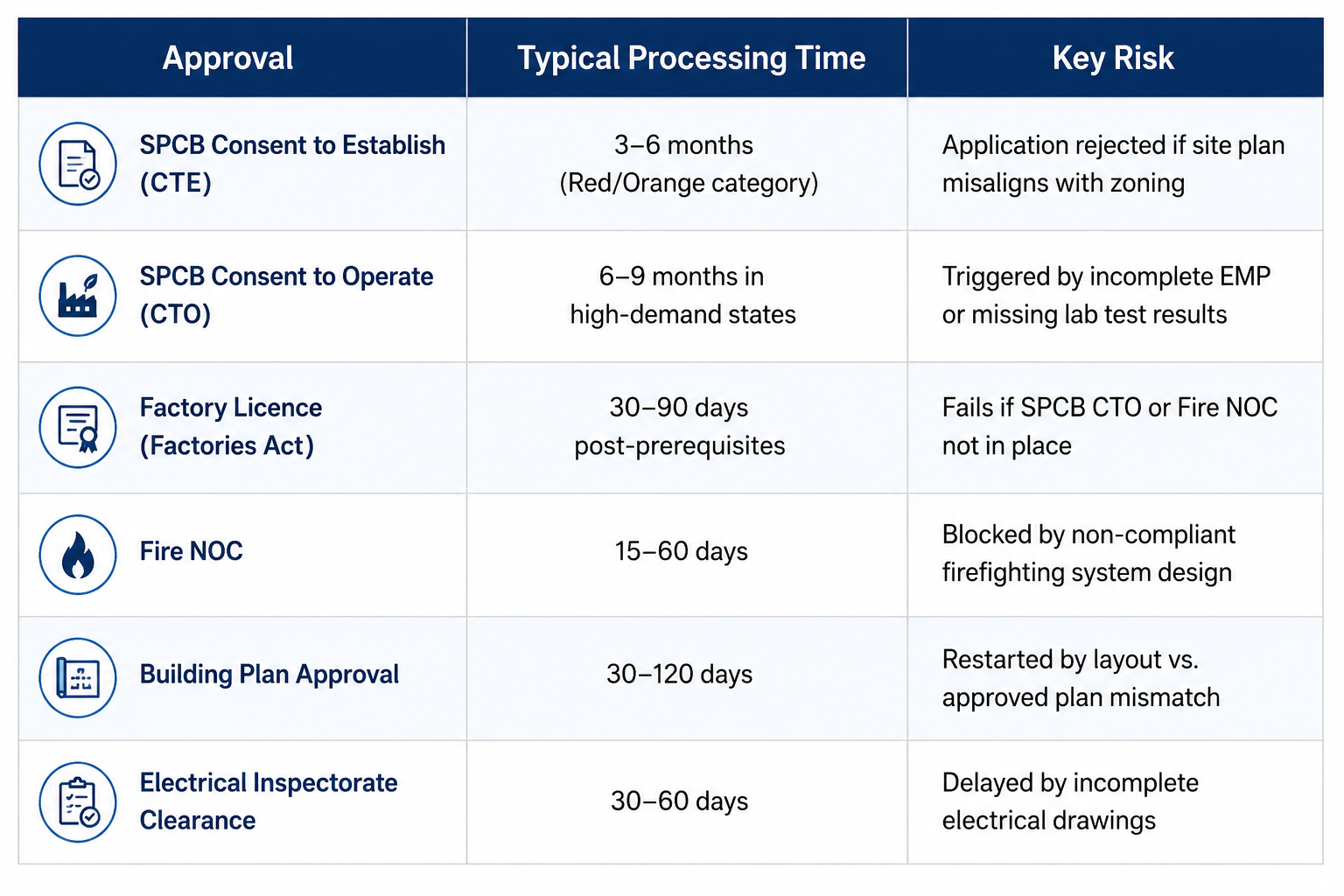
• SPCB Consent to Establish (CTE) must precede construction; Consent to Operate (CTO) must precede commissioning
• Factory licence under the Factories Act is issued only after CTE, building plan approval, and Fire NOC are in place
• Labour registrations Contract Labour Act, ESIC, EPFO activate upon first worker engagement, not at commissioning
• Explosive/Petroleum Act licences, Boiler registrations, and Electrical Inspectorate clearances run on separate tracks
Per DPIIT's Business Reform Action Plan (BRAP) scorecards, sequencing errors across approval tracks add 60 to 180 days cumulatively to manufacturing project timelines.
2. SPCB Consent Processing Timelines
Environmental consents from State Pollution Control Boards represent the longest single approval track in most manufacturing projects. In high-demand industrial states, CTO processing times have extended materially as application volumes have increased.
3. The Most Common Delay Triggers
Regulatory delays rarely originate from a single failure. They compound one missed step creates a bottleneck that holds every downstream approval in suspension.
• Wrong approval sequence applying for a factory licence before SPCB CTE and building plan approval results in outright rejection; the sequence restarts
• Documentation gaps at inspection pre-inspection document review is limited in most state systems; gaps in site plans, machinery lists, EMP reports, or ownership documents are caught only at the Inspector's visit, triggering re-inspection cycles of 45–90 days per occurrence
• State-specific documentation standards what is acceptable in one state inspectorate is frequently insufficient in another; manufacturers expanding into new states consistently underestimate this variation
• NSWS integration gaps SPCB consents and Fire NOCs in multiple states still require direct authority engagement; manufacturers relying solely on portal submissions face timeline miscalculations
• PLI milestone pressure hard commissioning deadlines incentivise rushed submissions; incomplete applications paradoxically extend timelines when returned for deficiencies
• Untracked query lapses authorities raise queries post-submission on a significant proportion of applications in major industrial states; untracked queries lapse silently, pushing manufacturers into a full second inspection or resubmission cycle
Delay Impact Benchmarking: What the Numbers Show
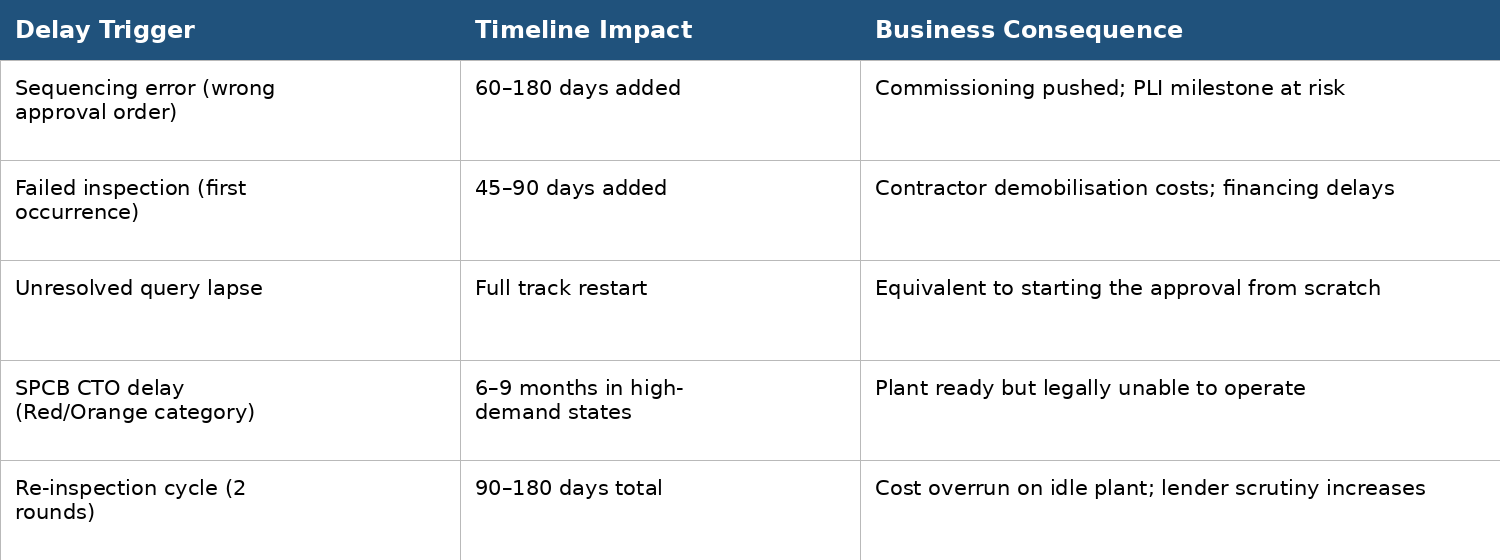
Business Impact: For a manufacturer with a ₹500 crore greenfield project and a PLI-linked production milestone, a 90-day commissioning delay at 12% capital cost implies approximately ₹15 crore in additional financing cost before accounting for contractor standby, missed incentive tranches, or customer penalties.
When to Engage Industrial Licensing Consultants
The correct point of engagement is before the first document is filed not after the first rejection. Manufacturers who engage consultants post-rejection face two simultaneous problems: remediation of the existing application and timeline restart. Two re-inspection cycles, which is common after an unguided first attempt, costs 90–180 days before the licence is back on track.
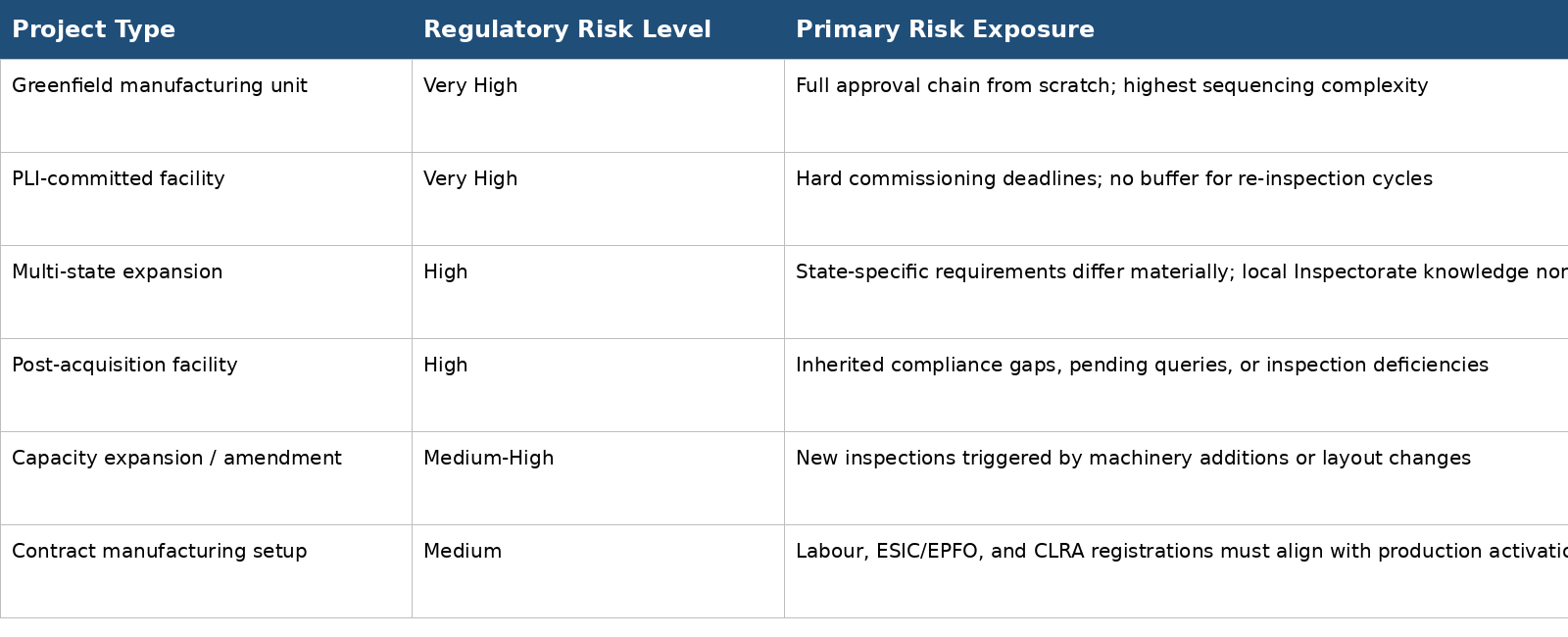
What Industrial Licensing Consultants Actually Do
1. Regulatory Applicability Assessment
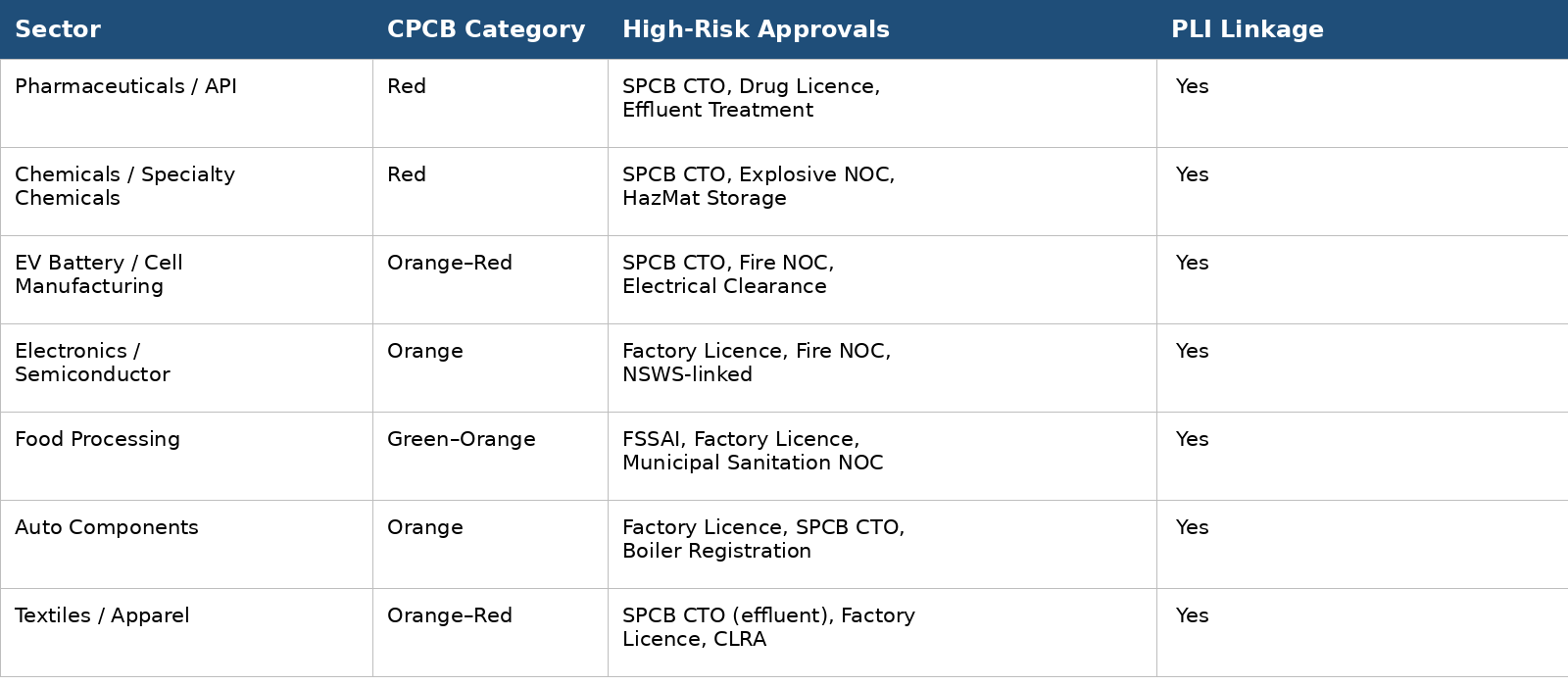
Before filing any application, consultants determine which Acts apply Factories Act, OSH Code 2020, or both and under which threshold (10+ workers with power, 20+ without). They classify the facility under CPCB's Red, Orange, Green, or White pollution category, which directly determines which SPCB consents are required and what their processing timelines will be.
Without this step, manufacturers file under the wrong framework. Rejections at this stage reset the entire application clock.
2. Approval Sequencing and Master Schedule
A greenfield facility requires clearances from 8–12 statutory bodies. Each runs its own portal, timeline, and inspection protocol. Consultants build a master regulatory schedule that maps approval dependencies, sequences submissions correctly, and runs parallel tracks wherever permissible.
Without sequencing expertise, manufacturers default to a sequential approach that adds 60–180 days to the overall timeline not because approvals are slow, but because they were never run in parallel.
3. Documentation Preparation and Verification
• Required documents include: approved building plans, machinery layout, connected load details, EMP/EIA reports, utility connections, worker strength declarations, land ownership or lease documentation
• Documentation gaps are the leading cause of re-submissions per State Factory Inspectorate data
• Floor plan vs. actual layout mismatches alone trigger re-inspection, adding 45–60 days per occurrence
• Consultants verify that what is submitted matches what the inspector will physically see on site not just what appears on paper
4. Pre-Inspection Readiness Audit
A failed inspection resets the timeline by 45–90 days, with no priority given to re-inspection slots. The most common failure points welfare facility shortfalls, electrical safety gaps, hazardous area segregation, fire system deficiencies are all identifiable and correctable before the Inspector visits.
Consultants conduct pre-inspection audits that replicate the Factory Inspector's checklist. Manufacturers who complete this step do not fail inspections. Those who skip it frequently do.
5. Query Tracking and Authority Coordination
After submission, applications generate queries, inspection notices, and compliance requests. Untracked queries lapse silently pushing manufacturers into a full second inspection cycle.
Consultants maintain live tracking registers across all open approvals. The difference between a consultant-managed application and a self-managed one is often not the quality of the initial submission it is what happens in the 30 days after filing.
How IMARC Engineering Supports Industrial Licensing & Compliance in India
IMARC Engineering provides end-to-end industrial licensing, regulatory approval, and compliance management services for manufacturers setting up or expanding operations across India.
• Regulatory applicability assessment first determine which Acts, thresholds, and CPCB categories apply before filing anything; avoids wrong-framework rejections that reset timelines
• State-specific expertise active presence across Maharashtra, Gujarat, Tamil Nadu, Telangana, Karnataka, Rajasthan, and other key industrial states with knowledge of local Inspectorate and SPCB requirements
• Master regulatory schedule full approval chain mapped and sequenced from Day 1; parallel tracks run simultaneously to compress the overall timeline
• End-to-end documentation management building plans, machinery layouts, EMP/EIA reports, connected load details, and worker declarations prepared to inspection-ready standard
• Pre-inspection audits site walkthroughs before the official Inspector visit to identify and remediate compliance gaps in advance of the inspection
• Query and resubmission management dedicated tracking across all open applications to ensure no query lapses unresolved and no approval track stalls silently
• Post-commissioning compliance annual returns, renewal management, SPCB CTO renewals, and ongoing Factories Act compliance to keep licences current and inspection-ready
Talk to our industrial licensing team : https://www.imarcengineering.com/contact?service=regulatory-compliance-services
For manufacturers with PLI-linked commissioning deadlines, multi-state expansion plans, or greenfield projects where approval predictability is non-negotiable, IMARC Engineering's regulatory services are structured to reduce timeline risk at every stage of the project.
Industrial Licensing Is a Project Management Function Not a Post-Construction Formality
A factory licence and its prerequisite approvals are not the last items on a manufacturing project checklist. They are critical-path dependencies that determine when your plant can legally operate, when contractors can demobilise, when financing drawdowns close, and whether PLI-linked production milestones are met.
The manufacturers who commission on time are not the ones who got lucky with approvals. They are the ones who treated regulatory clearances as a structured project management function from Day 1 with the right sequencing, the right documentation, and the right people tracking every approval in parallel.
The numbers are clear:
• Sequencing mistakes add 60–180 days to project timelines DPIIT BRAP scorecards
• Re-inspection cycles cost 45–90 days per occurrence, with no priority re-inspection slots
• SPCB Consent to Operate alone can take 6–9 months in high-demand industrial states
• A single query that lapses unresolved can restart an entire approval track
• Two unguided re-inspection cycles cost 90–180 days before the licence is back on track
For manufacturers who cannot absorb that kind of delay, regulatory planning is not optional it is a project requirement.
IMARC Engineering's industrial licensing and regulatory approval services are built specifically for manufacturers operating in this environment greenfield projects, PLI-committed facilities, and multi-state expansions where approval predictability is non-negotiable.
Contact Us:
IMARC Engineering
Phone: +91-120-433-0800
Email: sales@imarcengineering.com
India: C-130, Sector 2, Noida, Uttar Pradesh 201301
LinkedIn: https://www.linkedin.com/showcase/imarc-engineering/
- Education
- Economic Power
- Global