
KWT Spider 2.0: GEO & EEAT Are Finally Built Into Your SEO Crawl
Aug 4, 2026
first-story
Seeking
Visibility


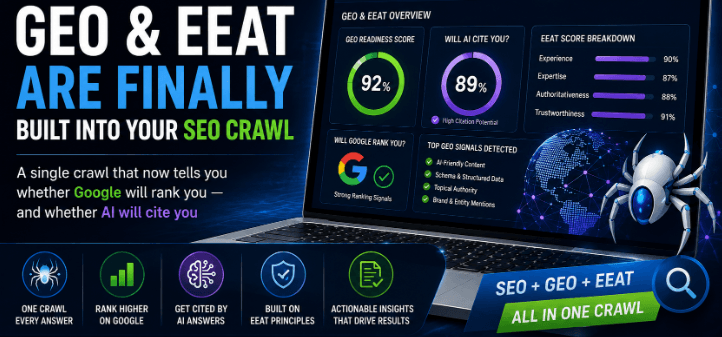
KWT Spider 2.0 introduces integrated GEO and EEAT analysis, helping SEO professionals evaluate both traditional search visibility and AI citation readiness in a single website crawl.
The Search Landscape Changed. Did Your Audit?
Here's an uncomfortable truth for anyone doing SEO in 2026: a growing share of your audience never sees your blue link at all. They ask ChatGPT, they read the AI Overview, they get an answer synthesized from five sources — and if your page isn't one of the five, you don't just rank lower. You don't exist in that conversation.
But most crawlers still can't tell you if you're one of the five. They'll happily point out a missing meta description, but they have nothing to say about whether an AI model would trust your page enough to cite it.
That's the gap KWT Spider 2.0 was built to close. Make yourself Aware with whast new today - in this you'll discover what GEO and EEAT is.
Meet GEO and EEAT — the metrics nobody was tracking
If you haven't run into the term yet: GEO stands for Generative Engine Optimization — essentially, SEO for AI answer engines instead of (or alongside) traditional search results. EEAT — Experience, Expertise, Authoritativeness, Trust — is the framework AI systems (and Google) increasingly lean on to decide which sources are safe to summarize and cite.
The problem is that these have mostly lived in blog posts and theory, not in tools. You could read about EEAT. You couldn't easily measure it, page by page, across your whole site, next to your regular crawl data.
KWT Spider 2.0 changes that. It now runs a full Generative Search (GEO) analysis as part of the same crawl that checks your titles, canonicals, and broken links — no separate tool, no separate process. Every page gets scored on:
- AI citation readiness — how likely a generative engine is to actually pull from this page
- Entity coverage – does the page clearly establish who/what it’s about, so that machines can parse it
- Trust and structure signals — the EEAT-adjacent markers that separate a source worth citing from one worth skimming past
- Fix hints — not just a score, but what to actually change
And it's not siloed off in some separate "AI tab" you have to remember to check. It sits right in the Overview as a site-level GEO/EEAT card, so the AI-readiness story is part of the same executive summary as your technical health score — because for a client or a boss, it should be. It's one more line in the "how healthy is this site" answer, not a separate report nobody reads.
Why this matters more than another crawl feature?
Every crawler adds features. Most of them are incremental — a new column, a faster export, a prettier chart. This one is different, because it's not improving how you audit for the search landscape you know. It's making sure you're not flying blind in the one that's replacing it.
Think about what's actually changed in the last two years: fewer clicks per query, more zero-click answers, and a growing slice of "search" traffic that isn't a search at all — it's a chat. If your entire audit process is still built around "does Google like this page," you're optimizing for a shrinking piece of the pie.
The teams that get ahead here aren't the ones who wait for GEO to become an established discipline with its own tooling ecosystem. They're the ones treating it as inseparable from technical SEO right now — same crawl, same audit, same report.
What this looks like day to day?
Practically, here's the workflow shift: you run your normal crawl — the one checking status codes, canonicals, duplicate content, all the fundamentals — and GEO analysis rides along automatically. No extra crawl, no extra tool subscription, no context-switching between "SEO mode" and "AI mode."
Per page, you can drill into a dedicated GEO detail tab showing citation score, EEAT breakdown, and structure suggestions — the same kind of forensic, page-level view you'd use to debug a broken canonical, just pointed at a different question. And if you're pitching a client or benchmarking against competitors, the new GEO Competitor Gap analysis shows you exactly where their pages are more AI-citable than yours, so you're not guessing at the gap — you're targeting it.
It also plays nicely with the more traditional side of "future-proofing." Alongside classic sitemaps, v2.0 now generates an llms.txt file — a small but telling detail. It's the kind of feature that only makes sense if you're taking AI agents seriously as a category of visitor, not a hypothetical one.
The bigger picture
None of this replaces the fundamentals. Broken links still break, thin content still dilutes rankings, redirects still chain into disasters. KWT Spider 2.0 didn't get worse at any of that — if anything, the large-site handling and stability improvements in this release make the core crawl work better than before.
What's new is that "is this page good" now has two answers instead of one: good for search engines, and good for the systems that are starting to answer questions for people instead of linking them out. Auditing for only the first one isn't wrong. It's just increasingly incomplete.
KWT Spider 2.0 is built for the version of search that's actually happening right now — not the one we all learned SEO on.
Conclusion
SEO isn't splitting into two disciplines — technical SEO and GEO. One discipline with a broader definition of "search." The sites that win over the next few years won’t be the ones that mastered AI optimization in isolation; they’ll be the ones that never allowed it to become a separate checklist in the first place.
That's the bet KWT Spider 2.0 is making. Run one crawl, get both answers: is this site healthy for the search engines you've always audited for, and is it healthy for the ones quietly taking over how people actually find things. If you're still treating GEO as a "someday" project, this is your reminder that the tooling has already caught up — the only question left is whether your site has.
- Technology
- Education
- First Story
- Shout Your Vision
- Internet Access
- Digital Skills
- Our Impact
- Global