
No peace without women
Sep 2, 2026
story
Seeking
Action
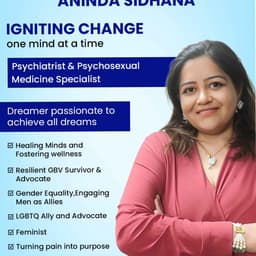


No peace without womem
From Golden Crowns to White Gowns: No Peace Without Women
Content note: This story discusses gender-based violence and its psychological consequences.
From golden crowns to white gowns.
From red carpets to the blood-red corridors of hospitals.
My journey has taken me through spaces that appear to belong to completely different worlds—from villages in India to international platforms, from rooms filled with celebration to rooms where people arrive carrying wounds no one else can see.
Across these spaces, I have learned one painful truth: gender-based violence does not care about a woman’s name, profession, education, wealth, culture, or social position.
Behind closed doors, pain speaks the same language.
As a psychiatrist and women’s mental-health advocate, I have witnessed how violence continues long after the visible injuries have faded. It can live in the body as fear, in the mind as shame, and in everyday life as silence.
A woman may continue working. She may smile for photographs. She may care for everyone around her. Yet, inside, she may still be struggling to feel safe.
This is why “Beti Bachao, Beti Padhao” must become more than a slogan.
Saving and educating girls is not enough if women later enter homes, workplaces, institutions, and public spaces where their dignity is negotiable. Laws written on paper cannot protect women unless justice is experienced in every street, workplace, hospital, and home.
Resilience should not mean asking women to hide their scars and carry on quietly. It should mean creating conditions in which they can speak, seek help, receive justice, and rebuild their lives without shame.
Yukta calls for Swabhimaan—the restoration of self-respect and dignity.
Patricia Elias, through No Peace Without Women, calls attention to the principles of United Nations Security Council Resolution 1325. The resolution recognizes that women must not be regarded only as victims requiring protection. They must participate fully and equally as leaders, negotiators, decision-makers, and architects of peace.
Women do not need permission to enter the rooms where peace is decided. Their place at those tables is not a favour. It is a right.
I am now participating in SIG Lab 2026: AI-Augmented Collective Intelligence and contributing to Team Momentum in support of this global call.
For me, SIG Lab is not simply a place where ideas are discussed. It is a testing ground. It asks us to examine what moves someone from awareness to understanding, from evidence to trust, and from private agreement to visible action.
Technology can help us identify patterns, test language, and connect people across borders. But this work must remain human-led, ethical, and grounded in real voices. Data can show us where exclusion exists, but empathy is what allows us to understand what that exclusion costs.
I also want men to enter this conversation—not as rescuers and not as silent spectators, but as accountable allies.
Ending gender-based violence cannot remain a responsibility placed upon women. Men must be willing to question what society has normalized, challenge harmful behaviour among other men, listen without defensiveness, and seek help when they need it.
True strength is not hiding behind a scar. True strength is having the courage to ask for help and allowing another person to do the same.
For me, spirituality is an inner anchor. It does not erase pain or replace justice, but it can help us remember that dignity is not something violence has the right to take away.
Let us hold space for one another’s stories.
Let us repair the systems that have failed.
Let us straighten one another’s crowns and walk together towards the stars.
No woman should have to prove her pain.
No survivor should have to heal alone.
No society can call itself peaceful until dignity and safety begin at home.
There can be no peace without justice.
No justice without dignity.
And no peace without women.
I invite every woman and every ally reading this to ask: What can I do today to turn private agreement into visible action?
- Peace & Security
- Positive Masculinity
- Global