
Technologically Facilitated GBV/VAW and AI: Why the VAW Ecosystem Must Evolve
Jun 22, 2026
story
Seeking
Action


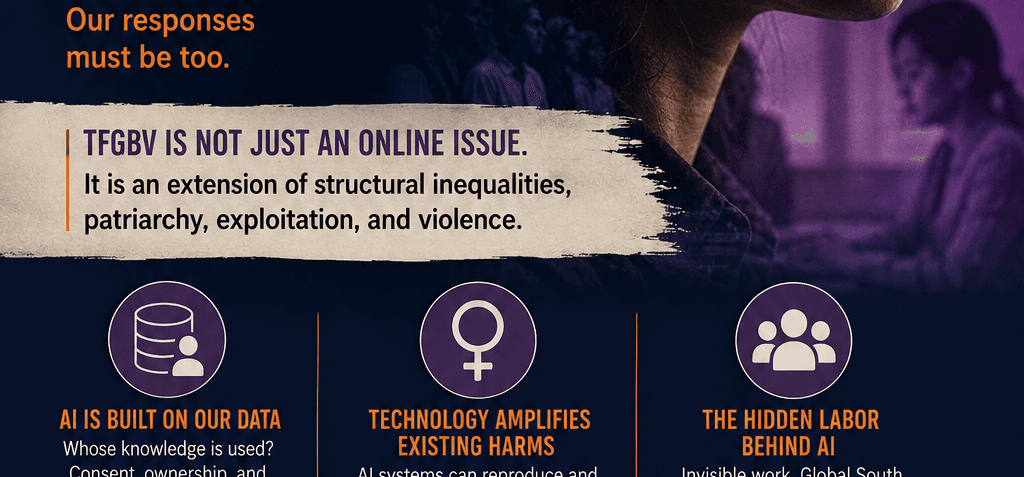
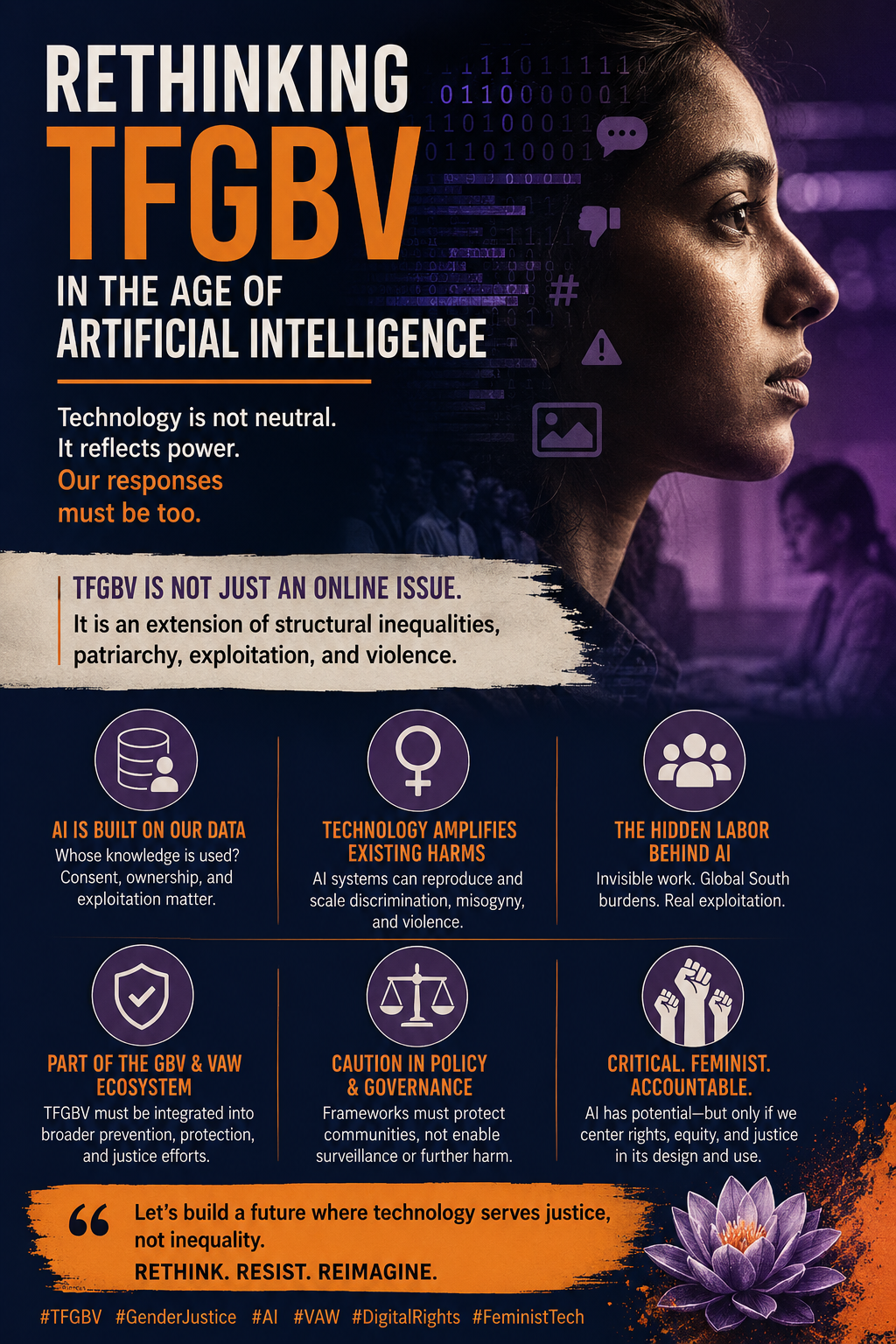
I recently participated in the GBV Prevention Network virtual webinar on 16 June 2026. The engagement was a critical reflection on Artificial Intelligence (AI), Technology-Facilitated Gender-Based Violence (TFGBV), where we delved to understanding the AI and TF-GBV/VAW in the broader Violence Against Women (VAW) ecosystem.
It was intriguing to see the direction of the conversation shift beyond concern about emerging technologies, to a deeper critique of how the VAW field itself is responding; and in many ways struggling to keep pace with rapidly evolving forms of violence, exploitation, and inequality.
The feminist activists and leaders in violence against women (VAW) prevention were called upon to challenge dominant narratives that frame artificial intelligence (AI) as inevitable, neutral, or inherently progressive. AI systems are neither objective nor detached from society; they are created by people, trained on human-generated data, and shaped by existing political, economic, racial, and gendered power structures. AI does not exist outside systems of patriarchy and inequality; rather, it can reproduce and intensify them.
This raises a critical question for the VAW ecosystem:: Is the field adequately evolving to confront the realities of technology-mediated violence and AI-driven harm?
For decades, GBV prevention and response frameworks have largely focused on violence occurring within physical spaces and interpersonal relationships. While these approaches remain essential, the rapid digitization of social, political, and economic life has transformed how violence is perpetrated, experienced, and amplified. Technology-mediated violence is no longer a niche or emerging issue; it has become a structural dimension of contemporary violence against women and marginalized communities.
Technology-Facilitated Violence Is a Feminist Justice Issue: One of the central critiques emerging is that TFGBV is too often treated as a technical or cybersecurity challenge rather than as an extension of structural violence rooted in patriarchy, inequality, and power. This framing risks depoliticizing digital harm and separating it from broader feminist struggles for justice, bodily autonomy, and equality. Treating TFGBV as a purely technical issue can lead to solutions that address the symptoms of abuse; such as improving digital security without confronting the deeper social and structural conditions that enable violence.
Digital violence does not exist independently from offline violence. Instead, technology often amplifies existing systems of harm. The same misogyny that restricts women’s voices and freedoms in physical spaces is reproduced online through harassment, intimidation, surveillance, and coordinated abuse. The same unequal power relations/ inequalities that limit women’s economic and social autonomy are reflected in digital systems through data extraction, algorithmic discrimination, and unequal access to technological power.
Across digital spaces, women and girls are experiencing cyberstalking, online harassment, non-consensual sharing of intimate images, sextortion, deepfake abuse, doxxing, digital surveillance, and algorithmic discrimination. Yet institutional responses remain fragmented, under-resourced, and frequently disconnected from mainstream GBV prevention and response systems.
This drew members to appreciate that AI and digital harms must therefore be understood through feminist and political lenses—not only technological ones. Interrogating these questions is central to understanding AI ethics and justice. These concerns are closely linked to issues of power, exploitation, and inequality. Whose Knowledge? Whose Data? Whose Labor?
A significant concern raised during the discussion was the foundation upon which AI systems are built. AI ethics is not only about how AI is used; it is also about how AI is created/built.AI systems rely on vast amounts of human-generated data, including images, language, online interactions, and personal information. Much of this data is collected and processed without meaningful consent, transparency, or accountability. This raises fundamental questions: Who owns the data? Who benefits from it? Whose knowledge and experiences are extracted? And who bears the risks when AI systems cause harm These questions are central to understanding AI ethics and justice because they reveal deeper issues of power, exploitation, and inequality.
From a Global South perspective, these concerns are particularly urgent. Many communities contribute data, knowledge, and digital labor that sustain AI development, yet they often have limited influence over how these technologies are designed, governed, and deployed. AI systems are frequently developed and controlled by institutions and companies in wealthier countries, creating conditions where data and knowledge from the Global South can fuel innovation and profit elsewhere while communities experience limited benefits and heightened risks of exclusion, biases and harm.
The discussion also highlighted the need for the VAW/GBV field to confront broader questions about digital capitalism, exploitation, and global inequality and challenged the assumption that AI is purely the product of technological innovation by highlighting the invisible human labor behind these systems.
AI depends on workers performing tasks such as data annotation, content moderation, image classification, transcription, and quality assurance. Much of this labor is outsourced to workers in the Global South, often under precarious conditions with limited protections. Content moderators, for example, may spend long hours reviewing graphic, violent, and abusive material, exposing them to significant psychological harm while receiving minimal recognition, support, or compensation. The realities of AI therefore require us to examine not only technological advancement but also the global systems of labor, inequality, and exploitation that sustain it.
AI Governance: Between Protection and Control: A critical concern about current approaches to AI governance was raised. While governments and institutions are developing regulatory frameworks, there are growing concerns that poorly designed policies may reinforce surveillance, state control, censorship, criminalization, and exclusion rather than advancing safety and justice.
AI governance is not inherently neutral. Decisions about regulation reflect choices about power, accountability, and whose interests are prioritized. Without meaningful participation from feminist movements, civil society, and communities most affected by inequality, AI policies may unintentionally reinforce existing systems of oppression.
For feminist movements and GBV/VAW prevention & response actors, this creates a necessary balancing act: engaging in policy and governance spaces while remaining critical of how legal and technological systems can themselves become tools of control.
Feminist participation in AI governance is essential to ensure that gender equality, human rights, survivor safety, and accountability are reflected in technological development. At the same time, feminist actors must continue questioning how surveillance technologies, biased algorithms, and digital regulations may reinforce discrimination or restrict freedoms, particularly among marginalized communities.
The goal is not to reject technology, but to ensure that technology is developed and governed in ways that advance justice.
Integrating TFGBV into the Future of GBV Prevention: Importantly, TFGBV must not be siloed away from broader GBV and VAW discourse. Doing so risks weakening both feminist organizing and institutional responses. Technology-facilitated violence should be recognized as part of the broader continuum of violence against women, rather than treated as a separate category. Digital harms such as online harassment, cyberstalking, image-based abuse, and AI-generated exploitation are deeply connected to physical, emotional, economic, and sexual forms of violence.
Addressing TF-GBV/VAW therefore requires integrating technology and AI-related harms into all aspects of GBV/VAW prevention and response; including survivor support, protection mechanisms, advocacy, accountability systems, and policy frameworks.
However, this integration requires more than adding digital safety components to existing programs. It requires a deeper transformation in how the GBV field understands violence itself: recognizing that violence increasingly operates across both physical and digital spaces and that effective responses must address the interconnected systems of power, inequality, and technology that enable harm.
Towards Feminist Digital Futures: The evolving nature of TFGBV demands interdisciplinary approaches that connect gender justice, digital rights, labor rights, data governance, cybersecurity, mental health, and human rights advocacy. It requires survivor-centered responses that recognize the realities of increasingly digitized lives and stronger Global South leadership in shaping AI governance and feminist technology discourse.
The GBV sector must move beyond reactive engagement with technology. Too often, responses to TF-GBV/VAW emerge only after harm has occurred. Yet AI and digital systems are already reshaping social norms, institutions, economies, and relationships. The movement cannot afford to remain conceptually behind these transformations.
Instead, feminist movements must actively participate in shaping how technology is designed, governed, and used. This requires anticipating emerging forms of harm, challenging unequal power structures, and ensuring that digital transformation advances safety, accountability, and human rights.
The paradox of our time is that innovation without justice can deepen inequality rather than reduce it. As technology reshapes our societies, the future of GBV and VAW prevention must grapple seriously with AI, digital power, and technology-facilitated harm.
This is no longer merely a conversation about online abuse. It is a conversation about power; who holds it, how it is exercised, and whose lives are shaped by it.
For feminist movements, the questions remain urgent: Whose knowledge is extracted? Whose labor is exploited? Whose bodies are surveilled? Whose voices are silenced? And whose safety is prioritized in increasingly technologized societies? TF-GBV/VAW is not a future concern for the VAW/GBV ecosystem. It is already reshaping the present. The challenge before the movement is to ensure that technology becomes a tool for justice rather than another mechanism through which inequality is reproduced.
- Leadership
- Technology
- Gender-based Violence
- Internet Access
- #EndGBV
- Stronger Together
- Global