
They Fought Till the Last Whistle, Till the Last Breath: Africa's Unyielding Spirit
Aug 3, 2026
story
Seeking
Encouragement

Fighting for the victory-in the field, in life.
Football has always been my favourite sport. As far as I can remember, I have been passionately following the FIFA World Cup since 2006, when I was in class six. Every four years, I eagerly wait for the tournament, cheering for my favourite team, Argentina. Besides, I try to enjoy the beauty of the game itself.
However, the 2026 World Cup felt different. It gave me something I had never experienced before. Although I continued supporting Argentina, I found myself watching every match with a new perspective. This time, I was deeply inspired by the remarkable performances of the African teams. Their determination, resilience, hard work, and even their heartbreaks made them one of the tournament's most unforgettable stories.
Around ten African countries participated in the 2026 World Cup: Morocco, Senegal, Egypt, Algeria, Tunisia, Ghana, Ivory Coast (Côte d'Ivoire), Cape Verde, South Africa, and the Democratic Republic of the Congo. Except for Tunisia, every African team progressed to the Round of 32 or even further.
Among them, Senegal, Cape Verde, and the Democratic Republic of the Congo impressed me the most.
To be honest, before this World Cup, I knew very little about Cape Verde. But after they held Spain to a draw in their opening match, they immediately caught my attention. Curious about this small island nation, I began reading about its history, its people, and its football journey. The more I learned, the more I admired them.
Senegal has always been a team I enjoy watching. They have consistently delivered strong performances in World Cups, but how they played against Belgium in the Round of 32 was truly outstanding. I have always admired the personality and leadership of their star player, Sadio Mané, whose determination and kindness inspires both teammates and fans.
The Democratic Republic of the Congo also wrote a remarkable story. After returning to the World Cup after 52 years, they advanced beyond the group stage for the first time in their history. Although they were eventually eliminated by England, they fought with incredible courage and determination until the final whistle. Their performance earned them the respect of football lovers around the world.
This story is not really about football. Rather, it is about something far greater than the game itself.
Before joining World Pulse, I had only a limited understanding of African countries. Like many people, I mostly defined them with poverty and underdevelopment. I knew they faced many challenges, but I never truly understood what those challenges meant in people's everyday lives.
Through the stories of my sisters from Nigeria, Uganda, Kenya, Cameroon, and many other African countries, I began to see a different picture. I learned about their struggles, their courage, and their determination to build better lives for themselves and their families. Many of them have written about poverty, food insecurity, conflict, gender inequality, and violence that continue to affect parts of their countries. Yet, despite these hardships, they refuse to give up. They keep moving forward with hope and extraordinary resilience.
That is why the performances of the African teams touched me so deeply during this World Cup.
I realised that many of these players are not only representing their countries on the football field, they are also carrying the hopes of people who have overcome countless obstacles. Despite limited resources compared with many traditional football powers, they stepped onto the world's biggest stage with confidence, discipline, and determination. They fought for every ball, every goal, and every opportunity.
What moved me most was the contrast. In some parts of the world, countries enjoy worldclass training facilities, modern stadiums, advanced coaching, and plenty of resources, yet they still fail to qualify for the World Cup. Meanwhile, teams from countries that have had to overcome far greater social and economic challenges surprised the world with their outstanding performances.
To me, that is the true meaning of resilience. It is the courage to keep believing, keep working, and keep fighting, even when the surroundings are against you.
At this point, I would like to share a few statements and moments that stayed with me throughout the World Cup. These words revealed that, for many African players, football is much more than a game. It is a way to represent their people, honour their homeland, and inspire those who continue to face hardship.
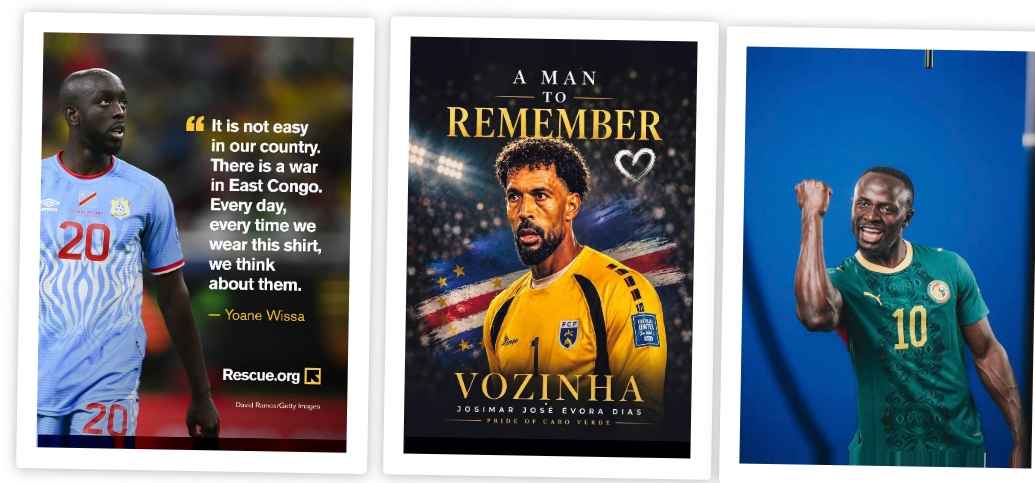
After the Democratic Republic of the Congo's narrow 1–0 defeat to England, one of their players, Yoane Wissa, spoke emotionally about his country. He explained that whenever he wears the national jersey, he thinks of the people back home who are living through conflict and uncertainty. His words reminded me that every match they played carried a purpose beyond winning. Although they were eliminated, they fought with courage until the very last whistle.
Cape Verde's goalkeeper, Vozinha, became one of the most inspiring figures of the tournament. At the age of forty, he earned admiration from football fans around the world through his outstanding performances. What touched me even more was his pride in representing his country. He shared that, before the World Cup, many people knew very little about Cape Verde. Now, because of the team's achievements, people across the world were searching for the country, learning where it is on the map, and discovering its history. For him, that recognition was a victory in itself.
Among all the African footballers, Sadio Mané remains my favourite. I have always admired not only his talent but also his humility and his commitment to his community. He has invested in schools, hospitals, and other projects that improve the lives of people in Senegal. On the field, he gave everything he had for his country. Senegal played with passion and determination throughout the tournament. Although they were defeated by Belgium 3–2, the disappointment on Mané's face reflected how deeply he cared. For him, representing his country was never just about football, it was about carrying the hopes of an entire nation.
After this World Cup, I realised that not only my view of football but also my perspective on people have changed.
From the inspiring performances of my African brothers on the football field to the powerful stories shared by my World Pulse sisters across Africa, I have learned to look beyond headlines. They have taught me that true strength is not measured by how easy life is, but by the courage to keep moving forward despite countless hardships.
Today, whenever I watch these teams play, I no longer see only footballers. I see sons, brothers, fathers, and dreamers carrying the hopes of families and communities that refuse to give up. I think of the many people who continue struggling for clean water, quality education, safety, healthcare, peace, and better opportunities. Despite conflict, poverty, and other challenges that affect many communities, they continue to rebuild their lives with courage, resilience, and hope.
Their spirit is something the whole world can learn from.
The final whistle ended their matches, but it did not end their fight. Their real struggle continues every day, far from the stadiums. That is why I believe they fought till the last whistle on the field and they continue fighting till the last breath in life.
- Leadership
- Moments of Hope
- Stronger Together
- Behind the Headlines
- Global