
When Democracy Becomes Meaningful
Sep 15, 2026
story
Seeking
Connections


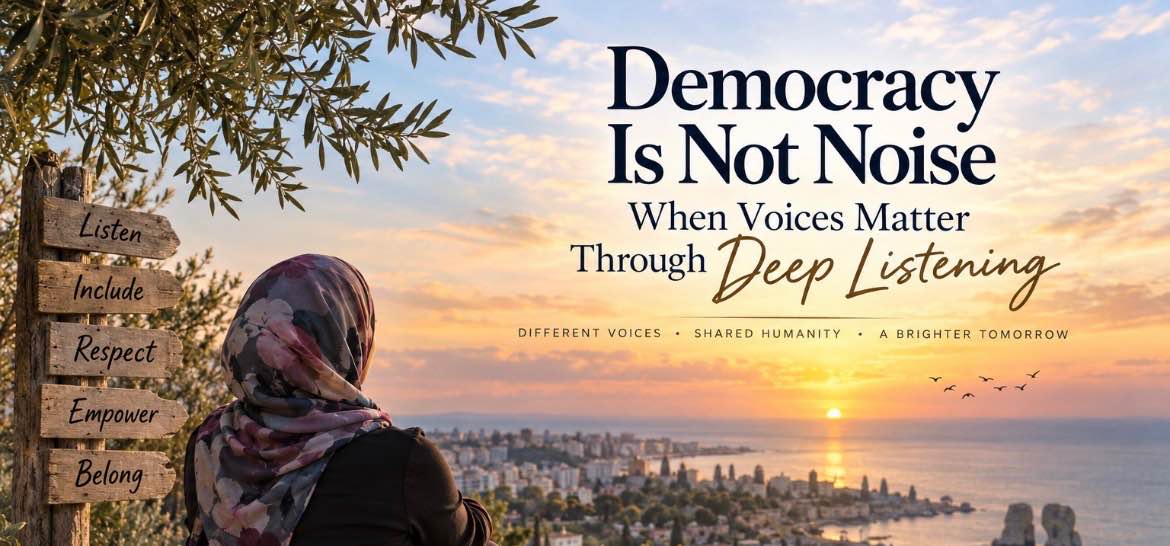
Democracy Is Not Noise: When Voices Matter Through Deep Listening
by Hawraa Ghandour
We are living in a world full of voices.
People speak through microphones, television screens, social media platforms, classrooms, parliaments, protests, and countless digital spaces. We have perhaps never had so many opportunities to express ourselves.
Yet I keep asking myself:
Are we really listening?
We are surrounded by noise. Everyone wants to speak. Everyone wants to respond. Everyone wants their version of the truth to prevail. Too often, we listen only long enough to prepare our next argument.
And sometimes we call this democracy.
But noise is not democracy.
For me, the deepest meaning of democracy is not found only in elections, constitutions, institutions, or the freedom to speak. These are essential, but democracy becomes truly human when a person’s voice does not merely exist—it matters.
And for a voice to matter, someone must be willing to listen.
When speaking is not enough
I come from Lebanon, a country where voices are many, identities are diverse, disagreements can be intense, and the consequences of division are not abstract lessons in a history book.
We know what happens when people stop hearing one another.
This has shaped the way I understand dialogue, education, and peace.
As an educator, I have learned that giving a child permission to speak does not automatically mean that child feels heard.
A student may raise a hand and still feel invisible.
A woman may tell her story and still feel dismissed.
A young person may express fear, anger, or hope and still feel that decisions are being made without them.
A community may be invited to a dialogue while knowing that its words will change nothing.
Having a voice and having a voice that matters are not the same thing.
That distinction, I believe, takes us to the heart of democracy.
Deep listening is a democratic act
I have spent much of my work speaking about deep listening, and increasingly I see it as more than a communication skill.
Deep listening is an act of democracy.
It does not mean that I agree with you.
It does not mean that I surrender my beliefs to accommodate yours.
It means that I recognize your humanity strongly enough to hear you before I judge you.
It means saying:
You do not have to think like me to deserve to be heard.
Imagine what this could mean in our classrooms.
Imagine children learning not only how to present an argument, but how to listen to one.
Imagine leaders listening not only to those who applaud them, but also to those who challenge them.
Imagine communities asking not only, “Who has spoken?” but “Whose voice is still missing?”
That is where inclusion begins.
We have more platforms—but are we more democratic?
Technology has given humanity extraordinary power to communicate. A message written in one corner of the world can reach millions of people within seconds.
But more communication does not automatically mean more understanding.
Our digital spaces can become echo chambers. We react before reflecting. We label before understanding. We sometimes attack the person instead of engaging with the idea.
The loudest voice can dominate while the most vulnerable voice disappears beneath the noise.
That should concern us.
Because democracy cannot simply mean that everybody has somewhere to speak.
Democracy must also mean that people have somewhere to be heard.
From voice to democracy
I see a simple human pathway:
VOICE → LISTENING → PARTICIPATION → DEMOCRACY
When voices are spoken, we have expression.
When voices are heard, we have inclusion.
When voices are deeply listened to, we create meaningful participation.
And when meaningful participation can shape our shared future, democracy becomes something we actually live—not merely something we define.
Perhaps, then, one of the great challenges facing democracy today is not that humanity has lost its voice.
Perhaps we are losing our ability to listen.
On this International Day of Democracy, my message is simple:
Do not only give people a microphone.
Give them your attention.
Do not only invite people into the room.
Allow their presence to matter.
Do not only teach our children to speak confidently.
Teach them to listen courageously.
And when someone thinks differently from us, perhaps our first question should not be:
“How can I prove you wrong?”
Perhaps it should be:
“What can I understand from you that I could not understand before?”
Because democracy does not need a world where everyone shouts louder.
It needs a world where we can disagree without dehumanizing, participate without excluding, and speak without silencing someone else.
Democracy begins with a voice.
But democracy becomes meaningful when that voice matters.
And voices matter when we truly listen.
In this increasingly noisy world, perhaps one of the most democratic things we can do is also one of the simplest:
Listen.
- Girl Power
- Peace & Security
- Human Rights
- Education
- Global