
Who Am I
Sep 1, 2026
story
Seeking
Visibility

Self
From Citta to Cortex: Can Ancient Ideas About the Mind Help Modern Psychiatry?
By Dr. Roop Sidana, MD (Psychiatry)
After more than four decades of practising psychiatry, I have learned that some of the most important things patients say are also the simplest.
One of them is:
“I don’t feel like myself.”
It is a short sentence, but it can mean many different things.
A person living with depression may feel disconnected from the person they once were. Someone with obsessive thoughts may become frightened by their own mind. A person experiencing psychosis may struggle with the feeling that a thought or action truly belongs to them. Someone experiencing dissociation may feel detached from their body or surroundings.
Modern psychiatry has made remarkable progress in understanding the brain. We can study neurotransmitters, circuits, brain networks and increasingly sophisticated models of how the brain processes information.
Yet a fundamental question remains:
How does the brain create our experience of being ourselves?
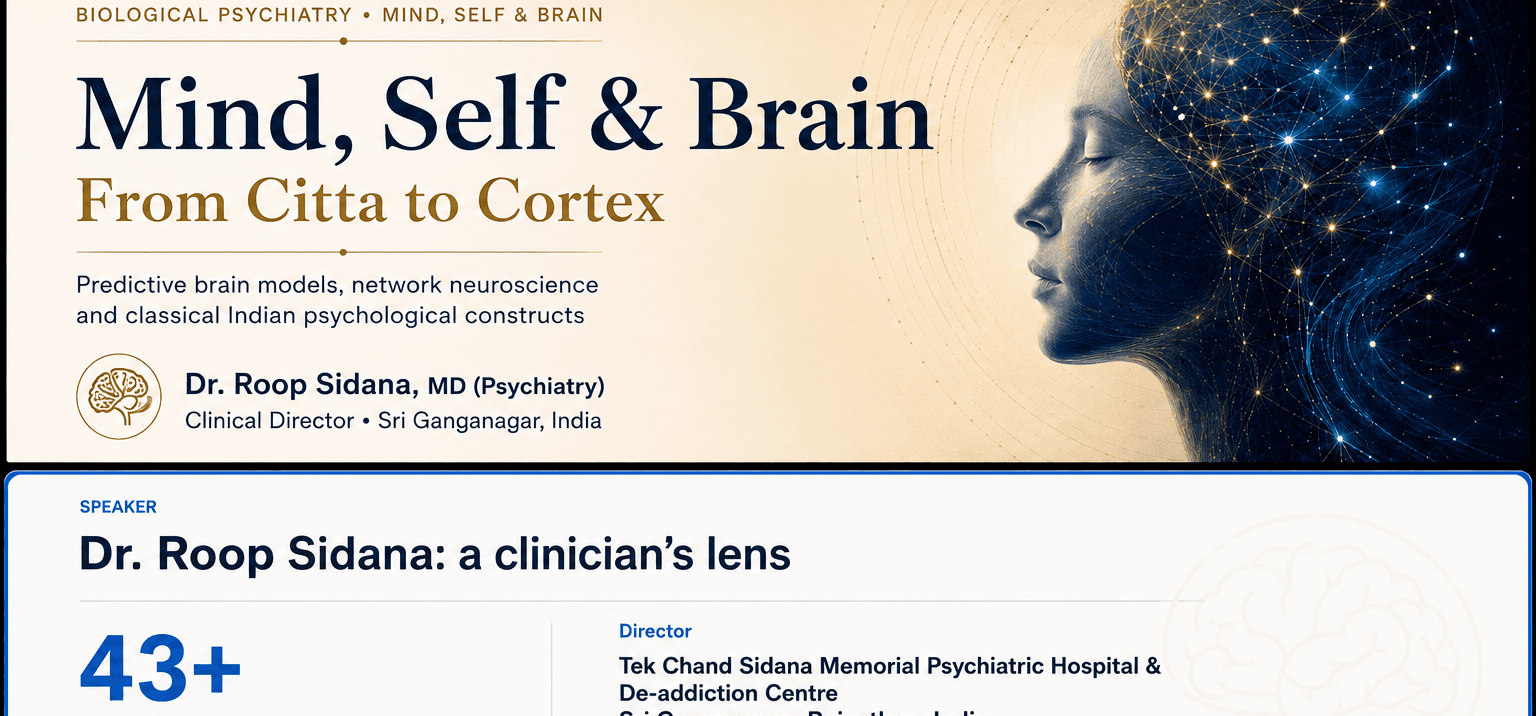
The presentation Mind, Self & Brain: From Citta to Cortex begins with precisely this problem: before asking where the self exists in the brain, we need to define which aspect of self—agency, ownership, continuity, boundary or identity—we are trying to understand.
Perhaps the Self Is Not a Place
We often imagine that science will eventually discover the particular part of the brain responsible for the “self.”
But the emerging picture is more complex.
Our sense of self appears to depend on many processes working together.
Our body gives us a sense of ownership. Our actions contribute to a sense of agency. Memory connects our past and present. Relationships and culture influence our identity. The stories we repeatedly tell ourselves help shape who we believe we are.
The self may therefore be better understood not as a single place, but as a continuing process.
This is where classical Indian ideas about the mind become interesting.
An Older Vocabulary of the Mind
Indian philosophical traditions spent centuries observing and describing human mental experience.
Terms such as citta, vṛtti, saṃskāra, buddhi and ahaṃkāra offer different ways of thinking about the movement of the mind, learned patterns, discernment and our sense of “I.”
For example, saṃskāra can be approached as a learned tendency that influences future experience.
Imagine someone who has developed the deeply held belief:
“I am a failure.”
That belief can influence what they notice.
They may remember criticism more readily than praise. They may interpret an ambiguous response as rejection. They may dismiss evidence that they are valued.
The past begins influencing how the present is perceived.
Modern neuroscience describes related questions through learning, expectations, attention and belief updating.
This does not mean that saṃskāra is a particular brain circuit.
It means that an old psychological idea may help us formulate a useful modern scientific question.
That distinction matters.
The original framework deliberately treats these connections as hypotheses rather than biological equivalences.
Ancient Wisdom Is Not Ancient Neuroscience
There is a temptation today to place an ancient Sanskrit term beside a brain scan and announce that science has “proved” what ancient traditions already knew.
We should resist it.
Ahaṃkāra is not simply the brain's default-mode network.
Buddhi cannot simply be labelled the prefrontal cortex.
And different Indian traditions should not be collapsed into one philosophy.
Science and philosophy ask different kinds of questions.
The value of bringing them into conversation is not to prove that one predicted the other.
It is to see whether one can help the other ask better questions.
Why This Matters to Patients
Ultimately, this conversation matters only if it helps us understand people better.
Instead of asking:
“What part of this person's brain is broken?”
we might ask:
What aspect of their sense of self is suffering?
What experiences keep that suffering alive?
What beliefs have become rigid?
What has happened to their sense of agency?
And where might flexibility be restored?
This does not make psychiatry less biological.
It makes our biology more connected to the person whose brain we are studying.
The goal is not another diagnosis or another label. It is a more precise and humane understanding of the individual.
From Citta to Cortex—and Back Again
Perhaps the most meaningful meeting between ancient Indian thought and modern neuroscience will not happen when we discover a brain region corresponding to an ancient word.
Perhaps it will happen when both traditions encourage us to observe the human mind more carefully.
After 43 years in clinical psychiatry, I remain convinced of something simple:
The patient's experience must remain at the centre of our science.
Technology will become more sophisticated. Brain imaging will become more precise. Computational models will become more powerful.
But the question that brought many of us into psychiatry will remain profoundly human:
What does it mean to experience a mind as my mind—and a life as my life?
That is a question worth carrying from citta to cortex.
And perhaps back again.
Dr. Roop Sidana, MD (Psychiatry)
Psychiatrist & Clinical Director
Sri Ganganagar, Rajasthan, India
43+ years of clinical psychiatry
Based on Dr. Roop Sidana's presentation, “Mind, Self & Brain: From Citta to Cortex — Predictive brain models, network neuroscience and classical Indian psychological constructs.”
- Peace & Security
- Leadership
- South and Central Asia